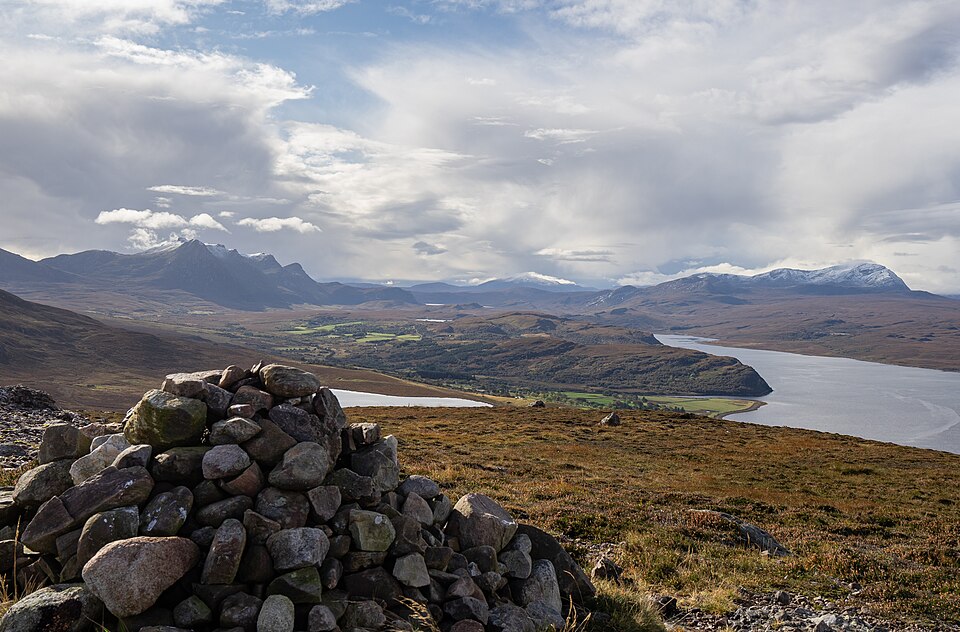
Most Munro bagging is a patient, one-hill-at-a-time affair, and there is nothing wrong with that. But there is another side to the game — the world of big rounds, ridge traverses and endurance challenges that push walkers and mountain runners to their limits. You will almost certainly never run a Ramsay Round, and that is fine; the point of knowing about these feats is not to copy them but to be inspired by them, and to realise that a magnificent multi-Munro day is within the reach of any fit, well-prepared walker. This is a look at the challenges at the sharp end, and how to build towards a great big day of your own.
The Ramsay Round
The Ramsay Round is the most famous Munro challenge of all: 24 Munros around Lochaber, roughly 58 miles and 28,000 feet of ascent, all within 24 hours. First completed by Charlie Ramsay in 1978, it links the Mamores, Ben Nevis and the Aonachs, and the Grey Corries into one continuous horseshoe around Glen Nevis, starting and finishing at the youth hostel. It is a mountain running feat of the highest order — a full day and night of relentless movement over serious terrain — and completing it inside the 24 hours puts you in very select company. It sits alongside the Bob Graham in the Lake District and the Paddy Buckley in Wales as one of the classic British 24-hour rounds.
The Tranter Round: the predecessor
The Ramsay did not appear from nowhere. It grew out of the Tranter Round, devised by Philip Tranter in the 1960s, which takes in 19 of the same Lochaber Munros — the Mamores and the Ben Nevis group — again inside 24 hours. Ramsay's contribution was to extend Tranter's line eastwards over the Grey Corries to bring the tally to a round 24 peaks. The Tranter is a formidable challenge in its own right and, for a very strong hillwalker rather than a runner, a slightly more attainable version of the same magnificent Lochaber horseshoe.
The continuous round of all 282
At the far extreme lies the continuous round — climbing every one of the 282 Munros in a single unbroken journey, on foot and by bike and boat, without the aid of a car. What began as a months-long expedition has become an outright endurance race: the fastest self-propelled rounds now come in under 32 days, an astonishing average of nine or ten Munros a day sustained for a month, over thousands of miles and hundreds of thousands of feet of ascent. It is the ultimate expression of the game, and while almost nobody will attempt it, it is worth knowing that the whole of the Munro list can, in principle, be strung into one continuous line.
Big days for ordinary walkers
Here is the encouraging part. You do not need to run to have a huge day in the hills — Scotland's great ridges hand you multiple Munros in a single walk, and bagging several summits at once is one of the most satisfying things you can do. The South Glen Shiel Ridge is the classic: seven Munros in one long, high traverse with relatively little re-ascent between them, and one of the best value days in the Highlands. The Mamores above Kinlochleven offer a superb horseshoe of four to six or more, depending on how you link them. The Grey Corries give a fine narrow ridge of three or four. These are proper mountain days, but they are walking, not running, and thousands of ordinary baggers complete them every year.
How to build up to a big day
A seven-Munro ridge is a serious undertaking, and you reach it by stages. Start by stringing two Munros together on an easy pairing, then a three or four-summit round, learning how your legs, your feet and your food hold up over a long day. Build the ancillary skills as you go: pacing so you do not burn out on the first climb, navigation for when a ridge disappears into cloud, and honest judgement about turning back. Get comfortable moving for eight, ten, twelve hours. Our guide to the best multi-day Munro routes is a natural next step, and pays off the fitness you build on single big days.
Pick your season and your ground
The long ridges are summer objectives for most walkers. Long daylight, dry rock and settled weather turn a seven-hour traverse from an ordeal into a joy, whereas the same ridge in winter is a full mountaineering route demanding axe, crampons and the skills to match. Time your big days for the settled spells and the long evenings — our guide to the best time to bag each region helps you line up the right ridge with the right month. Lochaber, home of the Ramsay Round, is superb for big days: base yourself at Fort William and the Mamores, the Grey Corries and the Nevis range are all within reach.
Aspiration, grounded
You may never toe the line for a 24-hour round, and you do not have to. What every walker can do is plan one brilliant, ambitious day — a ridge that gives you four, five, six summits in a single sweep, the sort of day you remember for years. Sketch the traverse in the Munros app, with the whole ridge, its summits and the escape routes stored offline on your phone, and you can see the whole line before you ever set foot on it — then tick each top in turn as the day unfolds. That is the spirit of these challenges brought down to size: not to race, but to dream up a great big day and go and have it.
Related guides
- Best multi-day Munro routes — where to take a run of big days
- Best time to bag each region — timing the long ridges right
- The complete packing list — what to carry on a big day out
Browse Related Hubs
Track your Munros
Log summits, get summit weather, and follow GPS routes for all 282 Munros. Free on the App Store.
Download the Free App