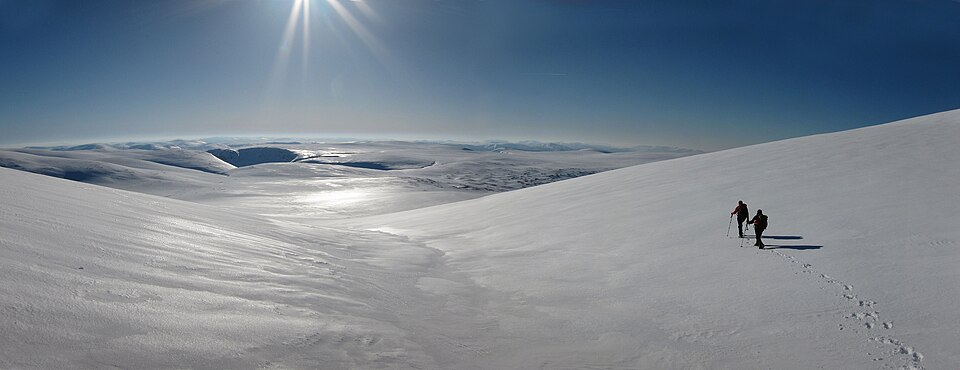
Braeriach and Cairn Toul are among the biggest, wildest and most remote mountains in Britain. Rising above the Lairig Ghru on the western side of the Cairngorms, they offer arctic plateau terrain, plunging corries, and a sense of space you'll find nowhere else in the country. They're usually climbed together in one long, committing day — and this guide explains how.
The mountains
Braeriach (1,296m) is Britain's third-highest mountain, a vast plateau ringed by dramatic corries and home to some of the highest-altitude springs of the River Dee. Cairn Toul (1,291m), the fourth-highest, is a shapelier peak nearby, often climbed with its neighbour Sgòr an Lochain Uaine (the "Angel's Peak"). Together they form the western wall of the Lairig Ghru, the great pass through the heart of the Cairngorms.
The approach is the challenge
These are not quick hills. The defining feature of any day here is the long approach — typically from Whitewell near Aviemore via the Lairig Ghru, or from the Sugar Bowl car park. Just reaching the foot of the climbing is a significant walk, and the full round of both Munros (often with the Angel's Peak) is a very long day — commonly 30km or more and a great deal of ascent, taking many walkers ten to twelve hours. Some prefer to split it with a wild camp or a night at Corrour Bothy.
Navigation on the plateau
The Cairngorm plateau is serious navigation country. It is vast, featureless in cloud, and ringed by cliffs and steep corrie headwalls — the ground that looks like a gentle slope on a map can end at a precipice. Confident map, compass and GPS navigation is essential, and in poor visibility the plateau is genuinely dangerous. This is a day for experienced hillwalkers comfortable in remote, high terrain, not a beginners' outing. Carry the kit to deal with a sudden change in the weather — the plateau makes its own climate.
Season and conditions
In summer, choose a settled, clear day and start early to give yourself the daylight for such a long round. In winter these become full arctic mountaineering objectives — short days, deep snow, whiteouts and avalanche-prone slopes — requiring winter skills and experience. For most walkers, a long June or September day with good visibility is ideal. These peaks are the wild heart of our Cairngorms bagging guide; if you're planning multiple days in the range, see best multi-day Munro routes.
Related guides
- Munro bagging in the Cairngorms
- How to climb Ben Macdui — the plateau's highest point
- Best multi-day Munro routes
- Munros tracking app — offline maps for the plateau and the Lairig Ghru
Browse Related Hubs
Track your Munros
Log summits, get summit weather, and follow GPS routes for all 282 Munros. Free on the App Store.
Download the Free App