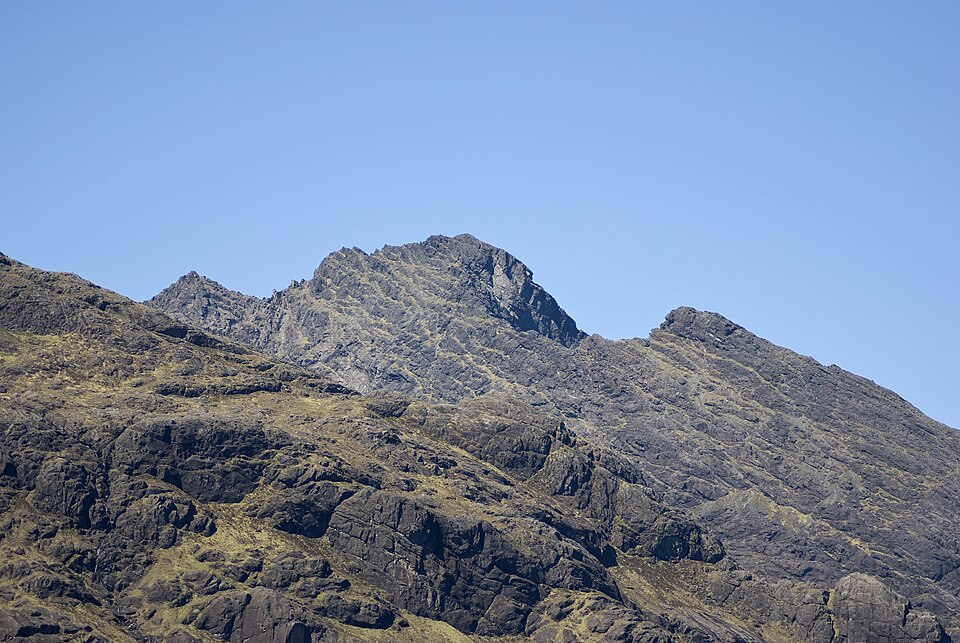
Sooner or later, every Munro round comes to the Black Cuillin of Skye — and for most baggers, this is where the project stops being a series of walks and becomes genuine mountaineering. The Cuillin holds the most serious Munros in Scotland, a jagged ridge of bare gabbro and basalt where the line between hillwalking and rock climbing all but disappears. If the other 270-odd Munros are a long-distance walk, the Cuillin is the crux.
Why the Cuillin is different
The Black Cuillin is unlike anywhere else in the Munros. The rock is rough gabbro that grips boots superbly but shreds skin and clothing; the ridge is narrow, exposed and complex, with few escape routes once you are committed; and the compass is unreliable because the rock is magnetic, so you cannot navigate the ridge the way you would anywhere else. There are eleven Munros strung along and around the main ridge, including Sgurr Alasdair (the highest point on Skye), Sgurr nan Gillean, Sgurr Mhic Choinnich and Sgurr Dubh Mor — almost all of which involve scrambling at a minimum.
The Inaccessible Pinnacle: the Munro you cannot walk up
The defining challenge is the Inaccessible Pinnacle — the "In Pinn" — a fin of rock on Sgurr Dearg that is the only Munro requiring rock climbing to reach the summit. There is no walking route to the top. It is graded as a Moderate rock climb, exposed on both sides, and it must be both climbed and abseiled. For the vast majority of Munroists, the In Pinn is the single peak that requires hiring a qualified guide, and it is frequently saved for last as the symbolic finish of an entire round.
How baggers approach the Cuillin
There are three broad approaches, depending on experience:
- Hire a guide. By far the most common choice. Skye-based mountain guides run the In Pinn and the harder Cuillin Munros daily through summer, providing the rope work, the route knowledge and the safety margin that the ridge demands. Even very experienced hillwalkers routinely guide the In Pinn.
- Pick off the easier peaks independently. A few Cuillin Munros, such as Bruach na Frithe, are within reach of confident scramblers in good conditions, and make a sensible introduction to the rock and the navigation before the harder summits.
- Commit to the full ridge traverse. The complete Cuillin Ridge traverse is one of the great mountaineering expeditions in Britain — a multi-day, roped undertaking far beyond ordinary Munro bagging, and not something to attempt without serious alpine and rock experience.
Planning a Cuillin trip
Weather is everything here. The gabbro is treacherous when wet, and cloud on the ridge removes the visual navigation you are forced to rely on, so wait for a genuinely settled, dry spell rather than a merely acceptable one. Wear robust footwear with sticky rubber, carry a helmet for the scrambling sections, and accept that you may travel to Skye and not get on the hill — the Cuillin keeps its own counsel. Approach it with patience and the right help, though, and these eleven peaks become the most memorable entries in the whole round.
Keep your Cuillin tick-list and notes in the Munros app so you can track exactly which of the eleven you have left — for most baggers, the Skye peaks are the ones that decide when the round is truly finished.
Related guides
- The hardest Munros in Scotland — where the Cuillin ranks
- Best Munro ridge walks — building up to serious ridges
- Isle of Skye Munros — all eleven Cuillin peaks
Munros in this article
Browse Related Hubs
Track your Munros
Log summits, get summit weather, and follow GPS routes for all 282 Munros. Free on the App Store.
Download the Free App