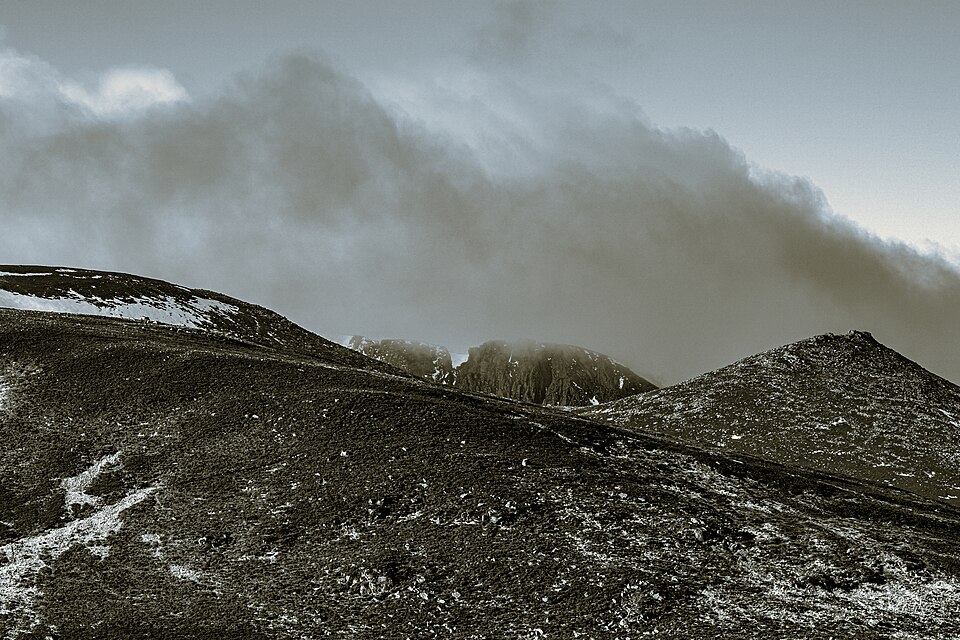
Lochnagar is the great mountain of Royal Deeside — a 1,155-metre massif rising above Balmoral that gave Lord Byron his "steep frowning glories of dark Lochnagar." Its true summit is Cac Carn Beag, but the mountain's fame rests on its enormous north-east corrie, a cliff-rimmed amphitheatre cradling a black lochan that is one of the most dramatic mountain scenes in the Cairngorms.
The classic route from the Spittal of Glenmuick
The standard ascent begins at the Spittal of Glenmuick car park, at the end of the public road up Glen Muick from Ballater. A good path leads across the glen and climbs steadily onto the mountain's shoulder, passing the col below Meikle Pap — where the full sweep of the corrie and its cliffs suddenly opens up, the finest viewpoint of the day — before a rocky final pull onto the summit plateau. It is a long but straightforward hillwalk on a good path; the Munros app lists the routes and their distances, which run to a full mountain day of several hours each way.
The great corrie
The north-east corrie is the reason to climb Lochnagar rather than any of its rounder neighbours. Its granite cliffs are a major winter climbing venue and a magnet for photographers — see our guide to the best Munros for photography for more on catching it in good light. Keep well back from the corrie edge, especially in winter when cornices build far out over the drop and are impossible to judge from above.
Extending the day: the White Mounth
Fit walkers can link Lochnagar with the neighbouring White Mounth Munros — Càrn a' Choire Bhòidheach and others — across the broad plateau to the west, making a big but rewarding round of quiet, rolling summits. As on all the high Cairngorm ground, the plateau is featureless and serious in cloud; confident navigation is essential once you leave the main path.
When to go and what to pack
Lochnagar is at its best from late spring to autumn. In winter it is a serious mountaineering proposition — the cliffs and corniced plateau edge have caught out many, and it should only be attempted with the skills and kit of a winter round. Whatever the season, carry warm layers, waterproofs, food, a headtorch and a map and compass, and check the mountain forecast before you set off — the summit weather bears little relation to the glen below.
Related guides
- Munro bagging in the Cairngorms — the wider range
- Best Munros for photography — where to catch the corrie in good light
- Cairngorms Munros — every peak in the region
Munros in this article
Browse Related Hubs
Track your Munros
Log summits, get summit weather, and follow GPS routes for all 282 Munros. Free on the App Store.
Download the Free App