Conival
“Adjoining Mountain”
Conival is a 987m Munro in the Assynt region, its Gaelic name meaning “adjoining mountain”. It stands 163rd of the 282 Munros by height. The usual ascent — Conival and Ben More Assynt from Inchnadamph — is a 20.2km round trip taking 5.3–6.9 hours, rated moderate (2/5).
There is 1 route to the summit of Conival, covering 20.2km.
The ascent of Conival takes you through classic Assynt terrain that demands both stamina and determination. Starting…
The ascent of Conival takes you through classic Assynt terrain that demands both stamina and determination. Starting from Inchnadamph Car Park, the route to Conival covers over 20 kilometres and involves navigating boggy ground, particularly in the lower sections where peat hags and wet moorland test your patience. As you climb higher towards Conival's 987-metre summit, the ground becomes rockier and the gradient increases, though the paths are generally well-worn.
The terrain is complex in places, with rocky outcrops and broken ground requiring careful foot placement. Conival is often tackled alongside Ben More Assynt, making this a substantial day in the mountains. The relatively short vertical ascent compared to the distance covered reflects the remote, undulating nature of this northwestern landscape, where the approach is as much part of the challenge as the climb itself.
Conival is best climbed between late spring and early autumn when daylight hours are generous and the ground conditions…
Conival is best climbed between late spring and early autumn when daylight hours are generous and the ground conditions improve. The Assynt region experiences unpredictable weather year-round, with Atlantic weather systems bringing sudden changes in visibility and conditions. Summer offers the longest days, essential for the 5-6 hour route, while September often provides clearer skies and fewer midges.
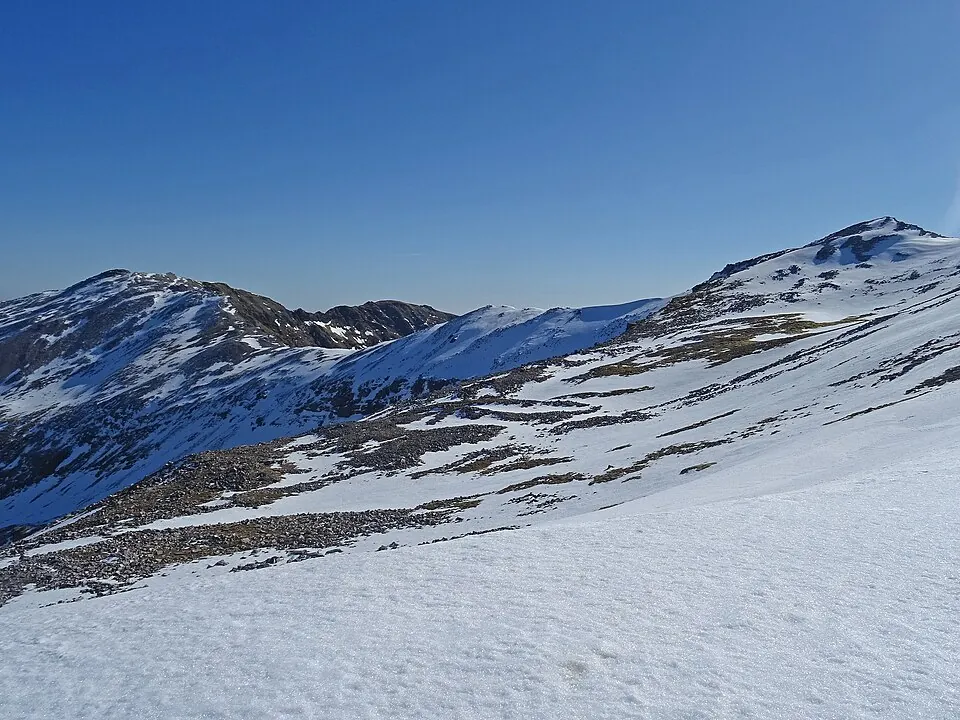
Winter ascents of Conival require full mountaineering skills as the summit plateau can hold snow well into spring, and navigation becomes significantly more challenging. The height of 987 metres means you'll encounter genuine mountain weather, with temperatures dropping considerably and wind speeds increasing as you gain altitude. Early starts are advisable to avoid afternoon cloud build-up that frequently envelops the Assynt peaks.
Check mountain forecasts specifically for this region, as conditions here can differ markedly from the Cairngorms or Central Highlands just hours to the east.
Access to Conival begins at Inchnadamph Car Park, located off the A837 between Lochinver and Ullapool in the…
Access to Conival begins at Inchnadamph Car Park, located off the A837 between Lochinver and Ullapool in the northwestern Highlands. This small car park sits beside the Inchnadamph Hotel and provides the starting point for the long approach into the heart of Assynt. The A837 is a single-track road with passing places in sections, requiring patient driving, but it's well-maintained and accessible year-round.
Inchnadamph is approximately 25 miles north of Ullapool and around 90 miles northwest of Inverness, making Conival one of Scotland's more remote Munros. Public transport options are extremely limited in this area, so a private vehicle is essential. The car park can fill quickly during peak season, so early arrival is recommended.
From the parking area at Inchnadamph, you face a considerable walk-in across moorland before even beginning the main ascent of Conival, so factor this distance into your day.
The summit of Conival offers a commanding perspective across the geological wonderland of Assynt. At 987 metres, you…
The summit of Conival offers a commanding perspective across the geological wonderland of Assynt. At 987 metres, you stand on a rocky plateau where quartzite outcrops create a distinctive white-grey landscape quite unlike anywhere else in Scotland. From Conival's cairn, the views stretch west to the Atlantic coast and the Summer Isles, while to the east lies the neighbouring peak of Ben More Assynt.
The summit itself is exposed with little natural shelter, so wind and weather are keenly felt at this altitude. On clear days, you can see south to the hills of Coigach and north towards the isolated peaks of Sutherland. The terrain around Conival's top is stony and broken, with numerous rocky tors and scattered boulders.
The sense of remoteness here is profound, with vast expanses of moorland and lochans visible far below, and the distinctive silhouettes of Assynt's ancient mountains dominating the horizon in every direction.
The approach to Conival takes you through diverse ecosystems shaped by Assynt's northwest coast climate. Lower slopes…
The approach to Conival takes you through diverse ecosystems shaped by Assynt's northwest coast climate. Lower slopes feature extensive boggy moorland with purple moor grass, cotton grass, and sphagnum mosses thriving in the waterlogged ground. As you gain height towards Conival, hardy heather and bilberry cling to drier patches between the rocks.
Above 700 metres, the vegetation transitions to montane heath, with mat-grass, crowberry, and various hardy sedges adapted to the exposed conditions. Red deer are common in the glens below Conival, while golden eagles patrol these vast hunting grounds from above. Mountain hares, with their seasonal coat changes, inhabit the higher slopes, and you may spot ptarmigan among the summit rocks of Conival, particularly in winter when their white plumage provides perfect camouflage.
The geology here is ancient and fascinating, with 3-billion-year-old Lewisian gneiss forming the base, topped by distinctive white Cambrian quartzite that gives Conival its characteristic appearance. Ravens and buzzards are frequent companions on the climb.
Climbing Conival demands thorough preparation and respect for this remote mountain environment. Navigation skills are…
Climbing Conival demands thorough preparation and respect for this remote mountain environment. Navigation skills are essential, as the long approach across featureless moorland and the complex summit terrain of Conival require confident map and compass work, especially when mist descends. Carry a GPS device or smartphone with downloaded maps as backup. The boggy sections on the approach can be energy-sapping, so allow extra time beyond the estimated 5-6 hours.
Waterproof boots with good ankle support are critical given the wet terrain and rocky upper slopes of Conival. Mobile phone signal is unreliable or absent throughout most of the route, so inform someone of your plans and expected return time. Carry plenty of water, as reliable sources are limited once you leave the lower glens. Weather on Conival can deteriorate rapidly, so pack full waterproofs, warm layers, and emergency shelter.
The remoteness means self-rescue may be your only option, so travel with experienced companions and turn back if conditions worsen. The combination of distance, terrain complexity, and isolation makes Conival a serious undertaking.
Explore more peaks near Assynt.
Common questions about climbing Conival.
Conival stands at 987 metres (3,238 feet), making it the 163rd tallest of all 282 Munros in Scotland.
The name Conival translates from Scottish Gaelic as “Adjoining Mountain”.
Climbing Conival typically takes between 5.3 and 6.9 hours round trip. This varies with fitness, weather, and the route chosen.
There is dedicated parking at the standard starting point for the main route up Conival, in the Assynt area. The exact car park location, map pin and arrival guidance are in the free Munros app.
Conival is rated Moderate (difficulty 2/5).
The most popular route up Conival covers 20.2km, 5.3–6.9 hours round trip.
Conival in the Assynt area is well suited to walkers with some hillwalking experience. Rated difficulty 2/5 at 987m, the paths are clear and the terrain is not technically demanding.
Conival is in the Assynt region of Scotland. Nearby Munros include Ben More Assynt.
Step-by-step directions, GPS navigation, exact parking and offline maps for Conival — free in the Munros app.
Free — Download on theApp StoreTrack all 282 Munros, plan routes, and log every summit. Join 2,400+ hillwalkers already using Munros.app.