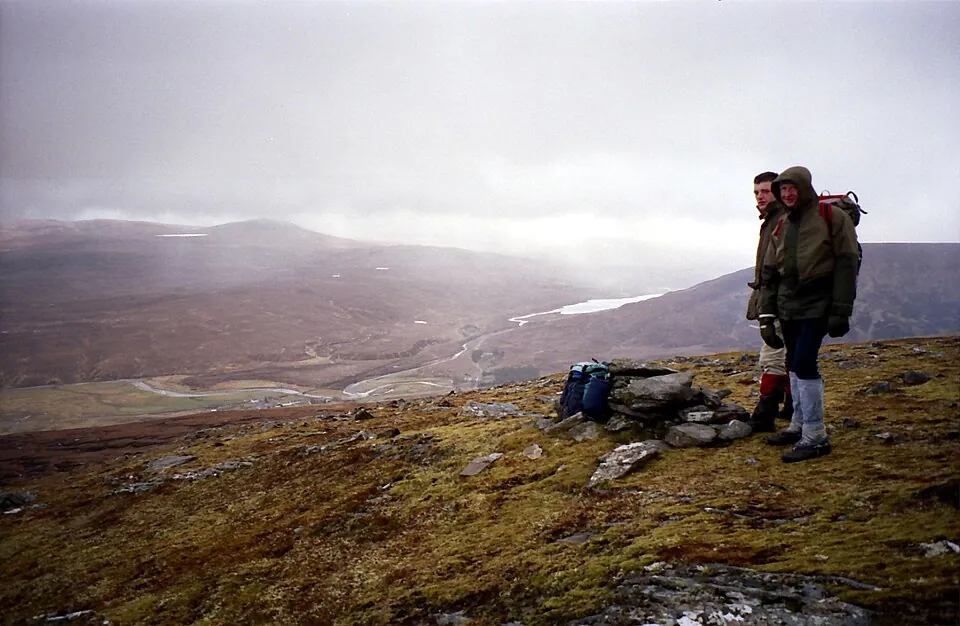
Ben Wyvis
1,046m
Ross-shire
“Mountain of Terror”
1,046mHeight
15.5kmRound trip
5.7–7.4hWalk time
ChallengingDifficulty 3/5
Photo: GeographBot · CC BY-SA 2.0
“Mountain of Terror”
Ben Wyvis is a 1,046m Munro in the Ross-shire region, its Gaelic name meaning “mountain of terror”. It stands 88th of the 282 Munros by height. The usual ascent — Ben Wyvis from Garbat — is a 15.5km round trip taking 5.7–7.4 hours, rated challenging (3/5).
There is 1 route to the summit of Ben Wyvis, covering 15.5km.
Ben Wyvis presents a unique challenge with its combination of pathless, boggy terrain and steady gradient. The route…
Ben Wyvis presents a unique challenge with its combination of pathless, boggy terrain and steady gradient. The route from Garbat begins through rough moorland where you'll quickly encounter the wet conditions that characterize this mountain. With a bog rating of 4/5, you'll need patience and careful foot placement throughout the lower and middle sections of the ascent.
As you climb Ben Wyvis, the gradient remains relatively steady rather than steep, but the lack of a defined path means you're constantly picking your route through the heather and bog. The upper slopes ease somewhat as you approach the broad summit ridge, though the wet conditions persist higher than you might expect. This is a mountain that tests your perseverance and navigation skills, with the pathless nature demanding constant attention to your route.
Ben Wyvis is best climbed during the drier months of late spring and early summer, though 'dry' is relative on a…
Ben Wyvis is best climbed during the drier months of late spring and early summer, though 'dry' is relative on a mountain with a bog rating of 4/5. Summer provides the longest daylight hours and the most stable weather patterns, essential for a route where progress can be slower than expected due to the wet conditions underfoot. The mountain's northern location means it experiences long summer days but very short winter daylight.
Weather in Ross-shire can be surprisingly dry compared to the western seaboard, though Ben Wyvis seems to create its own microclimate with persistent wetness. Winter transforms the mountain into a serious expedition requiring winter skills, with the featureless terrain becoming treacherous in snow and white-out conditions. Autumn brings stunning colours to the lower moorland but increasingly short days that make the lengthy route more challenging to complete comfortably.
The route begins at Garbat Car Park, located off the A835 northwest of Dingwall in Easter Ross. You'll find a…
The route begins at Garbat Car Park, located off the A835 northwest of Dingwall in Easter Ross. You'll find a well-maintained car park with space for a reasonable number of vehicles, though it can fill during busy periods. The car park is clearly signposted from the main road, making it straightforward to locate.
Dingwall is easily accessible from Inverness via the A9 and A835, making Ben Wyvis achievable as a day trip from the Highland capital. The area is served by public transport, with buses running to nearby communities, though you'll need to arrange the final approach to Garbat. The car park provides the only facilities in the immediate area, so ensure you're fully prepared before starting your walk.
The summit of Ben Wyvis, known as Glas Leathad Mòr, is a broad, grassy plateau that can be difficult to identify in…
The summit of Ben Wyvis, known as Glas Leathad Mòr, is a broad, grassy plateau that can be difficult to identify in mist. You'll find a substantial cairn marking the highest point, essential for navigation in the frequently cloudy conditions that afflict this mountain. The summit area is expansive and relatively flat, offering little natural shelter from the wind that often sweeps across the plateau.
On clear days, the views extend across Easter Ross to the Moray Firth and the mountains beyond, with the distinctive shapes of Sutherland peaks visible to the north. The broad summit of Ben Wyvis provides a unique mountain-top experience, quite different from the rocky, pointed peaks found elsewhere. The featureless nature of the terrain makes navigation critical in poor visibility, as the gentle gradients provide few obvious landmarks to guide your descent.
The approach to Ben Wyvis takes you through extensive heather moorland interspersed with blanket bog, creating important…
The approach to Ben Wyvis takes you through extensive heather moorland interspersed with blanket bog, creating important habitat for wading birds and raptors. The wet conditions support diverse plant communities including cotton grass, bog asphodel, and various sphagnum mosses. This is classic Highland bog habitat, ecologically important despite being challenging to walk through.
The eastern location brings slightly drier conditions than the west coast, though you wouldn't know it on Ben Wyvis.
Red deer are abundant across these moorlands, and you'll frequently see herds grazing or moving across the slopes. Mountain hares inhabit the higher ground, their coat colour changing with the seasons. Golden eagles hunt across this area, and you may spot them soaring on thermals. As you gain altitude on Ben Wyvis, the vegetation becomes increasingly montane in character, with grasses and sedges dominating the summit plateau.
The bog rating of 4/5 cannot be overstated—waterproof boots and gaiters are absolutely essential on Ben Wyvis, and even…
The bog rating of 4/5 cannot be overstated—waterproof boots and gaiters are absolutely essential on Ben Wyvis, and even then you should expect wet feet by the end of the day. Navigation skills are critical due to the pathless nature of the route and the featureless terrain, particularly on the summit plateau. Carry map, compass, and GPS, and be confident using them in zero visibility conditions that frequently occur.
The difficulty rating of 3/5 reflects the overall challenge rather than technical terrain, so don't underestimate this mountain based on its gentle gradients. Progress will be slower than on drier mountains due to the constant need to pick your route through wet ground. Phone signal is unreliable across much of Ben Wyvis.
Carry plenty of water and food, and be prepared for rapidly changing weather conditions that can transform the summit plateau into a hostile environment requiring all your mountain skills.
Explore more peaks near Ross-shire.
Common questions about climbing Ben Wyvis.
Ben Wyvis stands at 1,046 metres (3,432 feet), making it the 88th tallest of all 282 Munros in Scotland.
The name Ben Wyvis translates from Scottish Gaelic as “Mountain of Terror”.
Climbing Ben Wyvis typically takes between 5.7 and 7.4 hours round trip. This varies with fitness, weather, and the route chosen.
There is dedicated parking at the standard starting point for the main route up Ben Wyvis, in the Ross-shire area. The exact car park location, map pin and arrival guidance are in the free Munros app.
Ben Wyvis is rated Challenging (difficulty 3/5).
The most popular route up Ben Wyvis covers 15.5km, 5.7–7.4 hours round trip.
Ben Wyvis (difficulty 3/5 at 1,046m in the Ross-shire area) suits walkers with solid hillwalking experience. Expect rough or boggy ground on sections but no technical scrambling.
Ben Wyvis is in the Ross-shire region of Scotland. Nearby Munros include Fionn Bheinn.
Step-by-step directions, GPS navigation, exact parking and offline maps for Ben Wyvis — free in the Munros app.
Free — Download on theApp StoreTrack all 282 Munros, plan routes, and log every summit. Join 2,400+ hillwalkers already using Munros.app.